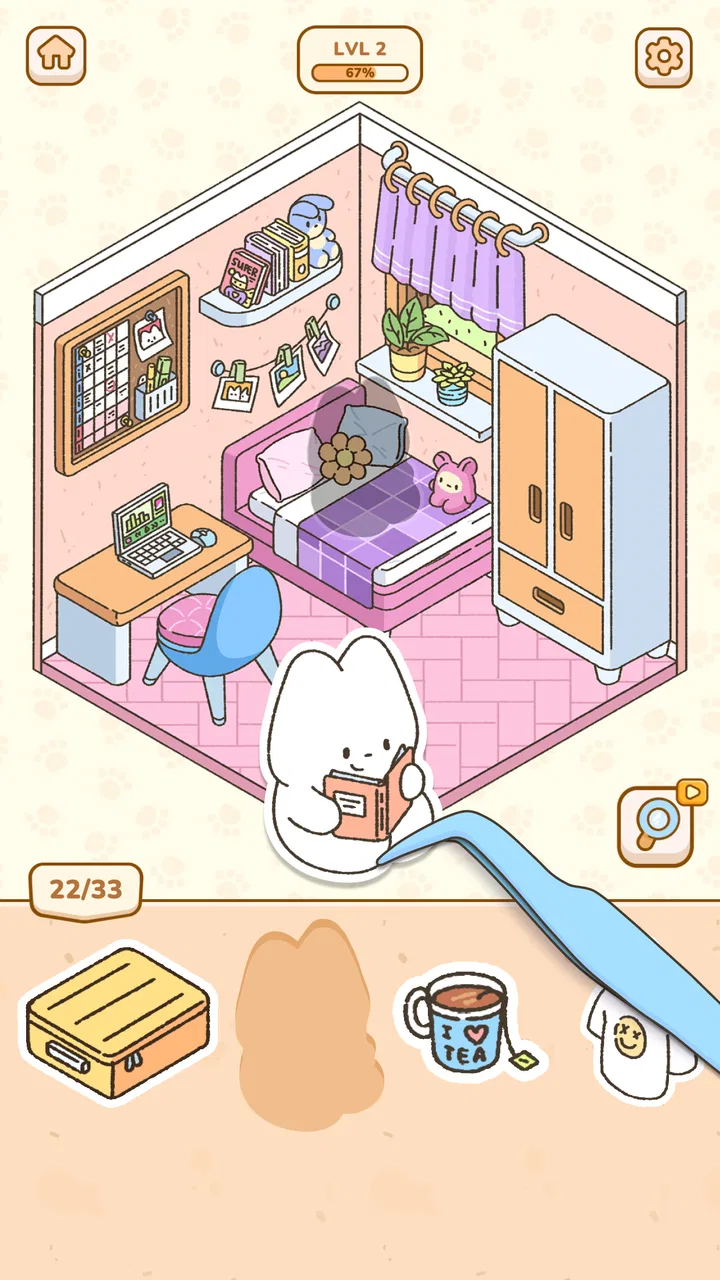
My Sticker Room - Decor Game
- 4.3
- Rating
- 10.00M
- Installs
- Free
- Price

 Analysis by App-foxy
My Sticker Room is the kind of simulation game I open when I want a small creative task rather than a demanding challenge. Its central appeal is simple: I decorate rooms with stickers, arrange cute visual details, and gradually turn plain spaces into something that feels personal. After spending time with it, my view is clear: this is a relaxing, accessible choice for players who enjoy decorating and collecting visual details, but it is not a substitute for a deep interior-design simulator.
That distinction matters. The game is made by SayGames Ltd and is available free of charge, so it is easy to try without committing money upfront. It sits in the simulation category, although its gentle pace and sticker-focused presentation make it feel closer to a casual creative toy than to a complex management game. I would recommend it to someone who likes short sessions, cheerful room makeovers, and low-pressure customization. I would be more cautious with anyone looking for detailed construction tools, realistic furniture planning, or a long strategic progression system.
What the decorating loop feels like in practice
The most enjoyable part of My Sticker Room is the immediate visual feedback. A room begins as a space that needs personality, and each decorative choice changes how it feels. Placing a sticker is not difficult, but deciding where it belongs can be surprisingly satisfying. I found myself thinking about balance: whether a wall looked too empty, whether several playful items competed for attention, and whether a corner needed one small detail instead of another large decoration.
You May Also Like

 Pandora - Music & Podcasts
Pandora’s Music Is Easy to Start, but Harder to Recover
Pandora’s strength is its low-effort path from a seed to a station. Its weak spot is how much confidence it asks you to place in connection, setup, and quiet recovery.

 8 Ball Pool
 Is Built on Rivalries, Rematches, and Routine
A close look at the rivalries, rematches, shared routines, and unanswered safety questions that turn a quick pool match into a persistent mobile community.

 Samsung Music
’s Quiet Strength Is Playing What You Already Own
Its reach comes less from spectacle than from dependable access to a personal library. That simplicity is both the app’s strongest retention engine and its ceiling.

 AccuWeather: Weather Radar
AccuWeather Review: A Quick, Clear Forecast for Everyday Decisions
For everyday plans, the best forecast is the one you can understand quickly. AccuWeather makes rain timing, radar, and local conditions easy to act on, with a few trade-offs.

 Hill Climb Racing
Why Hill Climb Racing Still Turns Crashes Into One More Run
A tiny car, a bumpy hill and one more upgrade: Hill Climb Racing keeps resurfacing because its simple chaos makes every near-miss feel personal.

 AliExpress - Shopping App
AliExpress Makes Global Shopping Feel Personal, but Shoppers Bear the Risk
AliExpress turns a global marketplace into a pocket-sized discovery engine. Its reach is useful, its shopping loop compelling, and its trade-offs easy to miss.
More From Our News Desk
View All News


That makes the game work well as a short-session experience. I can play for a few minutes while waiting for an appointment, finish a small decorating idea, and stop without feeling that I have abandoned a complicated task. The lack of pressure is one of its strongest qualities. There is no need to memorize systems or spend time learning an elaborate interface before the creative part becomes enjoyable.
The sticker concept also gives the game a distinct identity. A conventional room-design game often asks me to choose from furniture, flooring, lighting, and broad architectural elements. Here, the smaller decorative pieces are the focus. That changes the way I look at a room. Instead of only asking whether the furniture matches, I pay attention to the tiny visual accents that make a space feel playful, cozy, or deliberately themed.
My favorite way to use it is to start with one clear mood rather than placing everything I like immediately. For example, I might decide that a room should feel bright and cheerful, then keep the color and placement of stickers consistent with that idea. This approach produces a more convincing result than filling every available area. It is a small but useful lesson: restraint often makes a decorated room look more intentional.
Another practical tip is to treat empty space as part of the design. When I first began, I was tempted to cover every visible area because each sticker looked appealing on its own. The result was less readable, with individual elements losing their impact. Leaving breathing room around the most noticeable pieces makes the final arrangement easier to appreciate and gives the room a cleaner visual rhythm.
This is where the game’s casual design succeeds. It does not require artistic training, but it still gives me enough control to make choices that feel like my own. A child can enjoy the bright presentation, while an older player can approach the same room with a more deliberate eye for composition. The age rating is Everyone, and that broad audience fits the welcoming tone.
A creative break rather than a serious simulator
It is important not to approach this as a full interior-design application. The fun comes from arranging cute decorative elements, not from planning a realistic renovation. I am not using it to calculate room dimensions, compare materials, or reproduce a real home accurately. Its value is emotional and visual: it gives me a pleasant space to experiment with style without the consequences of making an expensive real-world mistake.
Compared with a traditional decorating simulator, the experience feels lighter and more focused. A more advanced alternative may offer greater control over furniture placement, room structure, color palettes, or architectural changes. That can be better for players who want to build a detailed virtual home. My Sticker Room is better suited to people who prefer quick decisions and charming details over technical precision.
Compared with a puzzle game, it offers less pressure and fewer moments of dramatic problem-solving. I am not trying to beat a difficult level or discover a complicated solution. The reward comes from seeing a room become more appealing. Players who need constant challenge may find the loop too gentle, while players who use games to unwind may appreciate exactly that quality.
The free entry point also makes the decision straightforward. I can install it, explore the basic experience, and decide whether the decorating style suits me before spending anything. There are in-app purchases ranging from $1.99 to $49.99 per item, so I would approach optional spending carefully. The sensible way to enjoy this game is to treat purchases as extras rather than as part of the minimum cost of trying it.
That spending structure is one of the points I would discuss with a younger player or a parent. The Everyone rating describes the content, not a promise that every player will make the same purchasing decisions. If the device is shared, I would make sure the person playing understands that optional items can cost real money. For me, the game is most appealing when the creative activity remains enjoyable without turning every new decoration into a reason to buy something.
Where the game is strongest
The strongest evidence in its favor is how quickly it communicates its purpose. I do not need a long explanation to understand what I am meant to do. The visual presentation points me toward decorating, and the room itself provides an immediate sense of progress. That clarity is valuable on mobile, where I often want to begin playing rather than study instructions.
I also like that the game encourages personal taste without demanding perfection. Two players can approach the same room differently and still feel satisfied with the result. One person may prefer a tidy, coordinated arrangement; another may enjoy a more colorful and crowded style. Because the activity is based on visual choices, there is room for experimentation even when the underlying action is simple.
A less obvious strength is that it can function as a gentle introduction to composition. I can use it to practice grouping related items, creating a focal point, and noticing when a design feels unbalanced. Those ideas are useful beyond the game, whether I am arranging a desk, choosing decorations for a bedroom, or organizing a digital profile. My Sticker Room does not teach these principles formally, but its format makes them easy to notice.
It is also a good fit for shared, informal play. I can hand the device to a friend or family member and ask which sticker should go in a particular spot. That turns a solitary decorating task into a small conversation. Because there is no complicated control scheme, someone who does not normally play mobile games can understand the appeal quickly.
The game’s popularity suggests that this accessible approach has found an audience. It has passed 10 million installs, carries an average rating of 4.6 from roughly 63 thousand ratings, and has about 1.1 thousand written reviews. Those figures do not replace personal experience, but they do indicate that the simple decorating idea connects with many mobile players.
Its current version is 1.3.3, and it was released on March 27, 2025. The minimum operating system is Android 8.0, which keeps the compatibility requirement relatively approachable for people using older supported devices. I would still check the store page on the particular phone or tablet before installing, especially if the device is used by a child or has limited storage, but the stated system requirement is not unusually demanding.
The limitation that shapes the whole experience
The same simplicity that makes the game welcoming can also make it feel narrow. Once I understand the basic decorating rhythm, I may want more ways to express a design idea. If my interest is specifically in detailed room planning, sticker placement alone may not provide enough depth for long sessions. The game is strongest as a compact creative activity, not as an endlessly demanding design workshop.
This limitation becomes clearer when I compare it with larger home-design games. Those alternatives often give players a broader range of decisions and may create a stronger sense of long-term ownership over a virtual home. My Sticker Room feels more focused on the charm of individual decorations. That focus is pleasant, but it means the experience may not satisfy someone who wants every part of a room to be adjustable.
I also think the format can encourage decorative overloading. When a game presents many appealing visual details, it is easy to confuse having more items with having a better design. I had to slow down and judge the room as a whole rather than react to each sticker separately. Players who enjoy maximalist arrangements will not see this as a problem, but anyone seeking a polished look should expect to edit their own choices mentally.
There is another trade-off in the free-to-play structure. The no-cost entry is convenient, but the presence of purchases can affect how I evaluate new decorative possibilities. I prefer games where the creative loop feels complete on its own, and I would not want to feel that the most attractive options are always positioned as paid temptations. Since individual purchases can reach $49.99, I would set a personal spending limit before browsing optional content.
For that reason, I would skip this game if my main goal were a completely unrestricted design tool or a purchase-once experience with no optional spending decisions. I would also choose a different category if I wanted competition, resource management, or a strong narrative. The game does not need to provide those things to be successful, but expecting them would lead to disappointment.
Who will get the most from it
I see My Sticker Room working best for players who enjoy visual customization but do not want a demanding game. It is a natural fit for a short evening wind-down, a quiet break during the day, or a casual activity shared with someone who likes cute design. The Everyone rating also makes it suitable for a broad range of ages from a content perspective, although adults should still be mindful of optional in-app spending on a shared device.
It is particularly appealing if I enjoy making small improvements and seeing a space become more expressive one choice at a time. I do not need to be good at drawing or interior design. The game gives me a set of visual pieces and lets me explore combinations, which lowers the barrier to creativity. That makes it more inviting than a blank canvas for someone who wants guidance without losing the feeling of choice.
A realistic everyday scenario would be using it after a busy day when I want something interactive but not stressful. I can open a room, try a few arrangements, notice that one area feels crowded, remove a piece, and settle on a cleaner composition. That kind of session does not require a large block of time or intense concentration. It gives me a small sense of completion without asking me to maintain a complicated virtual routine.
I would recommend it less strongly to players who measure value by depth, difficulty, or technical control. If I want to recreate my actual apartment, compare realistic furniture layouts, or spend hours optimizing a detailed environment, a fuller design simulator would be the better choice. If I want a daily challenge or a competitive goal, a puzzle or strategy game will probably hold my attention longer.
One useful way to decide is to ask what kind of satisfaction I want. If I want the satisfaction of making a room look cute and personal, this game is well targeted. If I want the satisfaction of mastering a system, beating opponents, or solving increasingly complex problems, its relaxed decorating loop may feel too limited. That is not a flaw in isolation; it is a question of matching the game to the mood I am in.
My verdict after living with the rooms
My Sticker Room succeeds because it understands the appeal of small creative decisions. It gives me a friendly way to decorate, experiment with visual balance, and create rooms that reflect a chosen mood. The sticker-centered approach separates it from broader home-design games, while the calm presentation makes it easier to pick up casually.
Its weaknesses are equally clear. The decorating concept may not offer enough depth for players who want realistic design tools, and the optional purchase range means I would keep an eye on spending rather than browse without limits. The game is also less suitable for anyone seeking competition, narrative progression, or demanding simulation mechanics.
For me, the final recommendation is positive but specific: try it if you want a free, approachable simulation game built around cute room decoration and short creative sessions. Begin by choosing a theme, leave some empty space, and judge the entire room instead of placing every attractive sticker immediately. That small adjustment makes the results feel more considered.
With its 4.6 average, broad install base, and straightforward free download, it is easy to see why the game has attracted attention. I would not call it a complete interior-design simulator, and I would not recommend spending automatically just because an optional item looks appealing. But as a low-pressure decorating experience from SayGames Ltd, it delivers a focused creative break with enough personality to make a simple room makeover feel worthwhile.
FAQs for My Sticker Room - Decor Game
01What is My Sticker Room - Decor Game about?
My Sticker Room - Decor Game is a creative and interactive app that allows users to design and personalize their own virtual rooms using a wide variety of stickers. Players can choose from different themes, styles, and decorative elements to create unique spaces. It’s a fun way to express creativity and explore interior design.
02Is My Sticker Room - Decor Game free to play?
Yes, My Sticker Room - Decor Game is free to download and play, but it may include in-app purchases. These purchases can enhance the gaming experience by unlocking additional sticker packs, themes, or customization options. However, players can still enjoy the core features of the game without spending money.
03What age group is My Sticker Room - Decor Game suitable for?
My Sticker Room - Decor Game is designed for a wide age range, typically appealing to children and young adults who enjoy creative games. Its simple interface and intuitive controls make it accessible for younger players, while the variety of design options can also engage older users who have a passion for decoration.
04Does My Sticker Room - Decor Game require an internet connection?
While My Sticker Room - Decor Game can be played offline, certain features like downloading new sticker packs or participating in online challenges may require an internet connection. Playing offline allows for basic gameplay, but connecting to the internet can enhance the overall experience with additional content and community interaction.
05Can I share my creations in My Sticker Room - Decor Game?
Yes, My Sticker Room - Decor Game offers social sharing features that allow you to share your decorated rooms with friends or on social media platforms. This feature encourages community interaction and lets players showcase their creativity, gather feedback, and even inspire others with their designs.
Pros
- Highly customizable sticker options.
- User-friendly interface for all ages.
- Regular updates with new content.
- Offline mode available for play.
- Interactive and engaging tutorials.
Cons
- In-app purchases can be pricey.
- Limited free sticker packs.
- Occasional ad interruptions.
- No multiplayer mode available.
- Requires frequent app updates.

My Sticker Room - Decor Game
Gallery